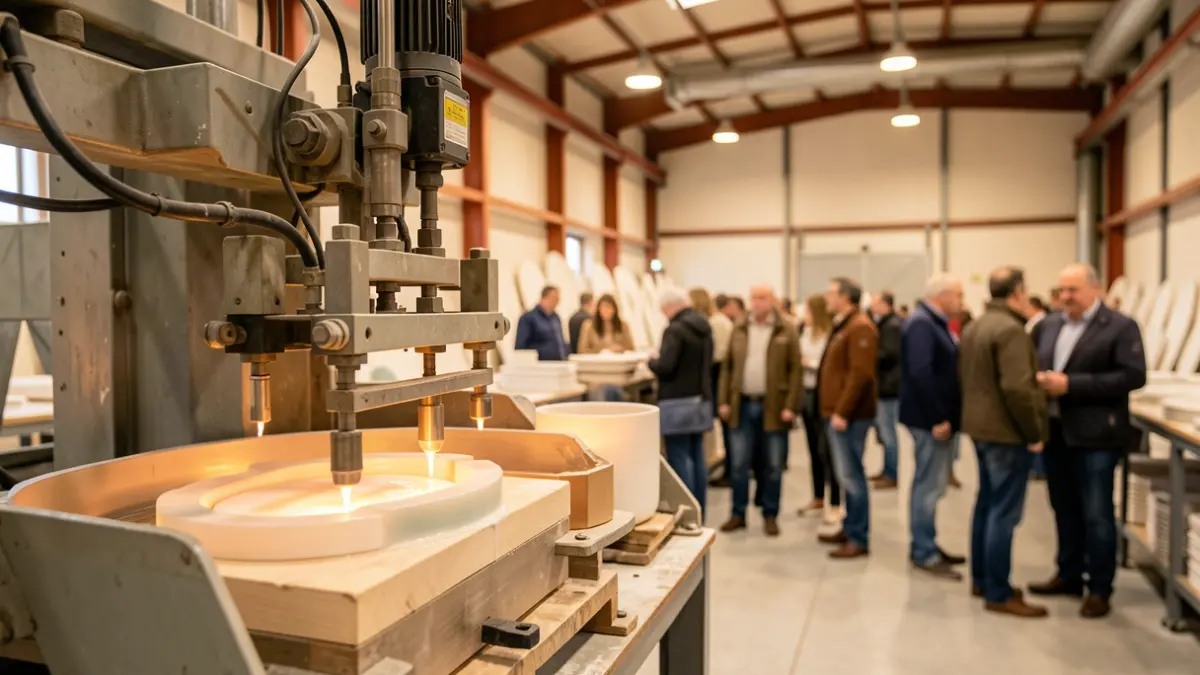
The E-Firing operation, promoted by Costa Verde and co-financed by COMPETE 2030, seeks to develop electric field sintering technologies to make porcelain production more efficient and reduce dependence on natural gas. The project combines the industrial experience of Costa Verde, the expertise of BRASTHERM in furnace development, and the scientific knowledge of the University of Aveiro.
Jorge Marinheiro, Technical Director at Costa Verde, highlighted the challenges of high energy consumption and reliance on fossil fuels in the ceramic industry. The company began its research in 2008, exploring technologies such as microwaves and hybrid ovens, now culminating in the E-Firing project.
The project aims to study electric furnaces for the first stage of porcelain firing (chacotagem) and single-firing processes. Professor Paula Vilarinho from the University of Aveiro explained that the goal is to apply electric field sintering technologies in an industrial setting, at laboratory and pilot scales.
Targets include reducing gas consumption by at least 60% and lowering the temperature by up to 30% and the chacotagem cycle time by up to 60%, optimizing energy efficiency. It also aims to develop an additive porcelain paste with properties equivalent to current ones and increase the mechanical strength of pieces by 10%.
The consortium brings together Porcelanas da Costa Verde, BRASTHERM, and the Universidade de Aveiro – DEMAC, combining complementary skills for the decarbonization of the ceramic industry and the creation of new ways to use energy.